How to Develop Critical Thinking and Decision-Making Skills in Business
Introduction
The ability to make quick, well-founded decisions is an essential skill for success. Critical thinking and decision-making are powerful tools for handling complex problems and navigating unexpected business situations. Developing these skills can bring enormous value not only to employees but also to the organisations they work for.
Critical thinking involves examining situations objectively and analytically, identifying and evaluating different perspectives and solutions, and reasoning logically when making decisions. This approach helps eliminate biases, unfounded assumptions and reasoning errors, leading to clearer, better-informed decisions.
Decision-making, on the other hand, means selecting the best option from the alternatives available in a given situation. It requires evaluating and comparing alternatives against the criteria that matter in that situation, then committing to a choice deliberately and confidently.
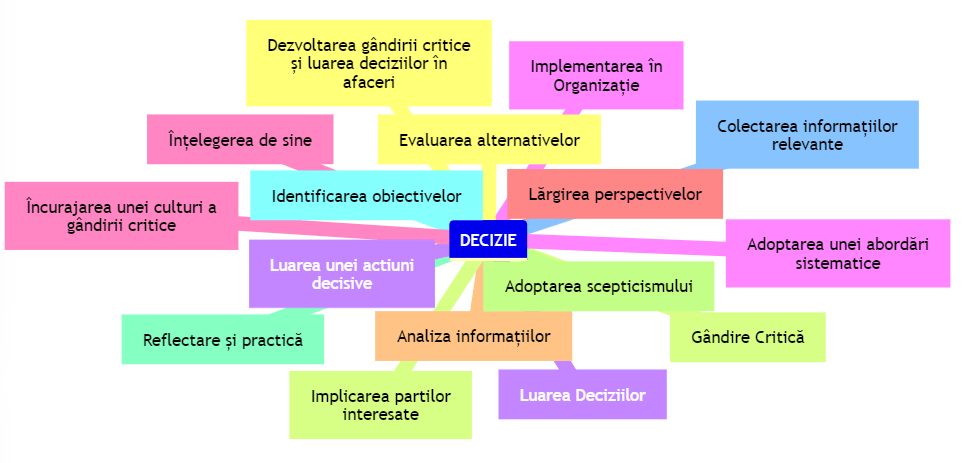
Both critical thinking and decision-making can be developed and improved through practice and experience. In this article, we explore concrete strategies for building these skills and applying them in business. We will look at the importance of cultivating curiosity, analysing information, making well-grounded decisions and adopting a systematic approach across every aspect of your work.
1. Developing Critical Thinking Skills
1.1 Cultivating Curiosity
Curiosity is the engine of innovation and of discovering new opportunities in business. By cultivating it, you develop a broader perspective and a deeper understanding of the different aspects of a business. Curiosity keeps you open to new ideas, helps you explore new approaches and makes it easier to adapt to market changes.
a. Ask Questions and Seek Explanations
One of the best ways to cultivate curiosity is to encourage yourself to ask questions and look for explanations. Take a proactive approach to gathering information and ask questions that help you dig deeper into the business. Your questions might concern how products or services work, what customers need and expect, competitors' market strategies or emerging industry trends. By asking questions and seeking answers, you build a deeper understanding of your business environment and can spot new opportunities for innovation and growth.
b. Stay Curious About New Technologies, Market Trends and Industry Insights
To keep your curiosity alive, stay up to date with new technologies, market trends and industry news. Read market reports, specialist articles and business magazines, and attend conferences and seminars in your field. Keeping up with the latest developments lets you continually expand your knowledge and uncover new opportunities for growth.
c. Encourage Curiosity Within Your Team
It is important to cultivate curiosity not just individually but also across your team. Do this by creating an open working environment where people are encouraged to ask questions, share ideas and explore new approaches. A culture of curiosity stimulates creativity and innovation and improves the organisation's ability to adapt to change.
By cultivating curiosity, you develop a critical-thinking mindset that helps you approach problems from different angles and discover innovative solutions. Curiosity can also help you build better relationships with customers, partners and colleagues and improve overall business performance.
1.2 Broadening Your Perspective
Broadening your perspective is fundamental to developing critical thinking and decision-making skills in business. A wider view lets you consider more variables and weigh more alternatives before making a decision.
a. Listen to and Understand Different Opinions
An effective way to broaden your perspective is to listen to and understand other people's opinions and viewpoints. Discuss ideas with colleagues, customers, partners and other stakeholders to get feedback and a better grasp of the different aspects of a situation. This gives you a more complete picture and leads to more informed, balanced decisions.
b. Analyse Alternative Scenarios
Another way is to analyse alternative scenarios and assess the implications and consequences of each. Scenario-analysis techniques such as simulations and risk analysis help you anticipate possible outcomes and gauge the potential impact of each option. This gives you a broader view of the possibilities and allows you to make more adaptable, flexible decisions as the situation evolves.
c. Explore New Ideas and Approaches
Broadening your perspective also means exploring new ideas and approaches to decision-making. Encourage creativity and innovative thinking in your team, attend professional development workshops and seminars, and experiment with new decision-making techniques and methods. The result is a broader, more diverse view of the situation and more innovative, effective decisions.
A wider, more open view lets you consider more variables and evaluate more alternatives, so you can make more informed, adaptable and effective decisions in an ever-changing business environment.
1.3 Analysing Information
Analysing information is an essential process in developing critical thinking and decision-making skills. It involves evaluating, synthesising and interpreting information to gain a deeper understanding of a situation and make better-founded decisions.
a. Check the Accuracy and Relevance of Information
The first step is to verify that information is accurate and relevant. Check your sources, compare the information with other data, and assess its context and applicability to your situation. Remember that information can be shaped by commercial interests, personal opinions and biases. Verifying accuracy and relevance helps you avoid errors and ambiguity and make more objective decisions.
b. Identify Relationships and Trends
Another important aspect is identifying relationships and trends. Analyse data to spot patterns and emerging trends, assess cause-and-effect relationships between variables and consider how different factors might affect the situation. Take a long-term view of developments in your business environment, too. This gives you a deeper, more holistic understanding and supports more strategic, forward-looking decisions.
c. Evaluate Options and Consequences
Once you have analysed the information, evaluate your options and the consequences of each decision. Compare pros and cons, assess the potential impact on stakeholders and consider the risks and uncertainties of each option. Also weigh your organisation's values and ethical principles, and consider the social and ethical impact of your decisions. This leads to more responsible and sustainable choices.
By analysing information systematically and rigorously, you develop a deeper, more objective understanding of the situation and make more informed, strategic and ethical decisions.
1.4 Embracing Healthy Scepticism
A sceptical attitude is an essential component of critical thinking and decision-making. Scepticism does not mean automatically rejecting information or ideas; it means evaluating them rigorously and analytically before accepting or rejecting them.
a. Ask Critical Questions
An effective way to practise scepticism is to ask critical questions and look for solid evidence and arguments supporting the information and ideas presented. Ask questions such as "Where does this information come from?", "What evidence supports this claim?", "What other interpretations or explanations are possible?" and "What implications and consequences could this idea have?" Critical questions help you assess ideas more rigorously and avoid accepting them without proper analysis.
b. Identify Biases and External Influences
Another key aspect is identifying biases and external influences that could distort information and ideas. Recognise and manage your own biases and cognitive tendencies, and watch for conflicts of interest, hidden agendas and external pressures. This allows you to evaluate ideas more impartially and avoid biased decisions.
c. Experiment and Test Ideas
Scepticism also means testing ideas before accepting or implementing them. Test hypotheses and assumptions through simulations, case studies and empirical analysis, and assess the results and potential impact in the real world. Take into account feedback from customers, employees, partners and other stakeholders. Testing ideas lets you validate or disprove them in a concrete, practical way and avoid rash implementation.
By evaluating information and ideas rigorously, you gain a deeper, more objective understanding and make more informed, impartial and validated decisions.
1.5 Reflection and Practice
Reflection and practice are essential for developing critical thinking and decision-making skills. They involve analysing and evaluating past experiences and applying the insights gained to practical business situations.
a. Understand and Analyse Past Experiences
An important step in reflection is reviewing past experiences. Evaluate past decisions and actions, identify the factors that influenced them and analyse their outcomes and consequences. Consider feedback from customers, colleagues, partners and other stakeholders as well. This gives you a more nuanced understanding and helps you avoid repeating past mistakes.
b. Apply Insights to Practical Situations
Once you have reflected, apply what you have learned. Use new knowledge and insights when making decisions and solving problems, experiment with new approaches and methods, and assess their impact and effectiveness in practice. Encourage and support colleagues in doing the same. This strengthens your skills and contributes to the organisation's growth.
c. Continuous Learning and Personal Development
Reflection and practice are also central to continuous learning. Attend professional development courses, seminars and workshops, read books and articles relevant to your field, and discuss ideas and experiences with colleagues, mentors and other professionals. Set personal development goals and review your progress regularly. Continuous learning builds stronger critical thinking and decision-making skills and supports both your career and your organisation.
By analysing past experiences and applying the lessons learned, you develop stronger, more effective skills and contribute to the growth of both your organisation and your career.
2. Improving Your Decision-Making Skills
2.1 Identifying Objectives
Clearly identifying your objectives is a crucial step in business decision-making. Setting goals helps you understand what you want to achieve, prioritise and choose the best alternatives to reach the results you want.
a. Clarify Your Vision and Mission
The first step is to have a clear vision and mission for your organisation. The vision is the ideal picture of the future you want to create; the mission is the fundamental purpose and direction you follow to get there. Clarifying both helps you understand what you want to achieve and set aligned objectives.
b. Define SMART Objectives
Next, set SMART objectives. Specific objectives are clear and precise; Measurable objectives can be assessed and tracked; Achievable objectives are realistic; Relevant objectives align with your vision and mission; and Time-bound objectives have defined deadlines and milestones. SMART objectives give you a clear, measurable direction and let you track progress.
c. Prioritise Your Objectives
Then prioritise them. Assess the importance, urgency and potential impact of each objective and tackle the most important and urgent ones first. Consider available resources and constraints, as well as potential risks and benefits. Prioritising lets you allocate resources and effort efficiently and reach your goals in a more organised way.
d. Communicate and Share Your Objectives
Finally, communicate your objectives to your team and stakeholders. Present them in meetings, discussions and documents, ask for feedback and encourage involvement. Sharing objectives creates common understanding and commitment and mobilises effort towards the desired results.
By setting SMART objectives, prioritising them and communicating them clearly, you gain a clear, measurable direction and achieve results in a more organised, effective way.
2.2 Gathering Relevant Information
Gathering relevant information is essential for making informed, effective decisions. It involves identifying, collecting and evaluating information that is relevant to your objectives and situation.
a. Identify Sources of Information
Start by identifying available, relevant sources: internal and external data and statistics, market reports and analyses, studies and surveys, customer and stakeholder feedback, and your own and others' experiences and observations. Assess the credibility, timeliness and relevance of each source before using it.
b. Collect Data and Information
Next, collect the data you need: gather statistics, read market reports, conduct surveys, request feedback from customers and stakeholders, and document experiences and observations. Collect information systematically and store and manage it efficiently.
c. Evaluate Quality and Relevance
Then evaluate the quality and relevance of what you have gathered. Check the credibility of sources, verify the accuracy and reliability of the data, analyse trends and patterns, and assess how significant they are for your objectives. Evaluate information critically and objectively, watching out for cognitive errors and biases.
d. Integrate Information Into Your Decision
Finally, integrate the information into your decision-making process. Use it to identify and evaluate alternatives, analyse risks and benefits, and anticipate consequences and outcomes. Use data in a balanced, rational way and combine it with your intuition and judgement.
By identifying, collecting, evaluating and integrating relevant information, you make better-founded, more effective decisions and reach your objectives in a more organised way.
2.3 Evaluating Alternatives
Evaluating alternatives is a crucial part of business decision-making. It means identifying and analysing the options available and assessing them against your criteria and objectives.
a. Identify the Alternatives
First, identify the options open to you: different strategies, solutions, products, services, partners, investments and more. Aim to generate as many alternatives as possible and stay open to new ideas. Take your resources and constraints into account to focus on options that are feasible.
b. Analyse Pros and Cons
Next, analyse the advantages and disadvantages of each alternative: benefits and costs, risks and rewards, impact and consequences, probabilities and uncertainties. Do this objectively and in a balanced way, considering all relevant factors.
c. Compare the Alternatives
Then compare the alternatives against your criteria and objectives in a systematic, organised way, weighing them according to your priorities and values.
d. Select the Best Alternative
Finally, choose the alternative that best fits your objectives and situation, typically the one offering the greatest benefits and rewards for the lowest costs and risks. Make an informed, rational decision and be prepared to accept and manage whatever outcomes follow.
By identifying, analysing and comparing alternatives and selecting the best one, you make better-founded decisions and achieve your desired results more effectively.
2.4 Involving Stakeholders
Involving stakeholders is an essential stage in business decision-making. It means communicating and collaborating with the people and organisations who have an interest in your decisions and may be affected by them. Doing so improves your understanding of the situation and its needs, builds acceptance and support, and increases the likelihood of success.
a. Identify Stakeholders
First, identify who has a stake in your decisions: customers, suppliers, employees, shareholders, partners, competitors, government, the community and others. Map as many as possible and consider their interests and needs.
b. Communicate With Stakeholders
Next, keep them informed. Explain the situation and your objectives, the alternatives and criteria, the pros and cons, and the expected impact. Communicate openly and transparently, and be receptive to their feedback and questions.
c. Collaborate With Stakeholders
Then involve them in the decision-making process. Ask for their feedback, suggestions, contributions and support. Collaborate constructively and for mutual benefit, taking their perspectives and values into account.
d. Understand and Respect Stakeholders
Finally, respect their interests and needs and make decisions that align with them. This may mean adjusting your objectives, criteria, alternatives or assessments. Aim for balanced, fair decisions and act responsibly and ethically towards stakeholders.
By identifying, communicating and collaborating with stakeholders and respecting their interests, you make better-founded decisions and achieve results in a more balanced, responsible way.
2.5 Taking Decisive Action
A key part of decision-making is the ability to act decisively once a choice has been made. This means implementing the decision and adapting to changing circumstances with a proactive, consistent approach.
a. Implement the Decision
Once you have decided, act quickly to implement it. Put plans and strategies into action, allocate resources and take responsibility for the results. Have a detailed action plan and make sure everyone involved understands it and is committed to it.
b. Monitor Progress
As you implement the decision, track progress and results. Check whether actions are being carried out as planned and assess their impact on your objectives. Monitoring helps you spot problems and obstacles early so you can adjust your plan and stay on course.
c. Adapt to Changing Circumstances
In an ever-changing business environment, flexibility is crucial. As the situation shifts, your original plan may need adjusting. Adapting keeps you relevant and effective and ensures your decisions stay aligned with current goals and needs.
d. Evaluate the Results
After implementation, evaluate the results and determine whether your objectives were met. Analyse the data collected and compare outcomes with your targets. Evaluation helps you understand successes and failures and provides valuable lessons for future decisions.
e. Learn and Improve Continuously
Use the experience to learn and improve. Reflect on your decision-making process: what went well, and what could you do better next time? Continuous learning makes you a more efficient and effective decision-maker.
By implementing decisions, monitoring progress, adapting to change, evaluating results and learning continuously, you achieve your objectives and make your decision-making process more effective and efficient.
3. Integrating Critical Thinking and Decision-Making
3.1 Adopting a Systematic Approach
Business decisions often involve complex problems, and choosing the best course of action can be challenging. A systematic approach helps clarify problems, evaluate options and identify the best solutions.
a. Define the Problem
Start by defining the problem clearly and precisely. Identify needs and objectives, analyse the relevant factors and conditions, and set criteria and standards. A clear definition gives you context and a framework for evaluating options.
b. Identify the Options
Next, identify the options for solving it. Explore alternatives and approaches, investigate sources and resources, and consider benefits and risks. This widens the range of possible solutions and improves the quality and diversity of your decisions.
c. Evaluate the Options
Then evaluate the options against your criteria. Compare pros and cons, analyse impact and consequences, and estimate costs and benefits. This helps you determine which options are most feasible and effective and select the best solution.
d. Implement the Solution
Put the chosen solution into action: execute plans and strategies, assign resources and responsibilities, and monitor progress and results.
e. Review the Results
Finally, review the results to see whether the objectives were met and the problem solved. Analyse the data, compare results with your criteria and assess successes and failures. Reviewing results helps you understand the effects of your decisions and improve your process in the future.
Defining the problem, identifying and evaluating options, implementing the solution and reviewing the results lets you tackle complex, multifaceted problems in a more structured way and make better-founded decisions.
3.2 Fostering a Culture of Critical Thinking
Critical thinking is essential to decision-making because it enables you to analyse problems, evaluate options and identify effective solutions. Creating and maintaining a culture of critical thinking in your organisation can improve the quality of decisions and help achieve its goals.
a. Promote Independent Thinking
Encourage people to form their own opinions, ask questions and develop their own perspectives. Independent thinking stimulates creativity and innovation and enriches the diversity of ideas and solutions.
b. Create an Open and Inclusive Environment
Value diverse opinions and perspectives, listen to and respect different viewpoints, and avoid prejudice and discrimination. An open, inclusive environment strengthens collaboration and improves communication and understanding.
c. Encourage Curiosity and Learning
Promote exploration and discovery, encourage questions and research, and offer opportunities for learning and development. This enriches knowledge and experience and expands horizons and possibilities.
d. Give Constructive Feedback
Recognise efforts and achievements, discuss weaknesses and areas for improvement, and offer suggestions and recommendations. Constructive feedback supports development and encourages performance and excellence.
e. Recognise and Reward Critical Thinking
Value and celebrate contributions and achievements, offer awards and rewards, and highlight role models. Recognising critical thinking motivates and inspires people and improves engagement and satisfaction.
By promoting independent thinking, creating an open and inclusive environment, encouraging curiosity and learning, giving constructive feedback and rewarding critical thinking, you improve the quality of decisions and help your organisation achieve its goals.
Conclusion
Developing critical thinking and decision-making skills is essential for success. These skills help you tackle complex problems, evaluate options and identify effective solutions, and they are vital in any decision-making process.
As discussed in this article, there are several strategies for improving critical thinking and decision-making in business:
- Developing critical thinking, which involves cultivating curiosity, broadening your perspective, analysing information, embracing healthy scepticism, and regular reflection and practice. These skills help you analyse problems and options and identify the best solutions.
- Improving the decision-making process, which involves identifying objectives, gathering relevant information, evaluating alternatives, involving stakeholders and taking decisive action. These steps help you approach complex problems in a structured way and make better-founded decisions.
- Fostering a culture of critical thinking within the organisation, by promoting independent thinking, creating an open and inclusive environment, encouraging curiosity and learning, giving constructive feedback and rewarding critical thinking. These actions enrich knowledge and experience and expand horizons.
By strengthening your critical thinking and decision-making, you can approach complex, multifaceted problems in a more structured, effective way and make better-founded, more effective decisions.
Recommended Reading
- Thinking, Fast and Slow by Daniel Kahneman: explores two modes of thinking, one fast and instinctive, the other slow and deliberate, and their impact on decision-making.
- The Art of Thinking Clearly by Rolf Dobelli: presents a series of cognitive errors we make when thinking and deciding, with suggestions for avoiding them and making better decisions.
- Thomas H. Davenport's work on analytics-driven decisions (e.g. Competing on Analytics): explores how organisations can combine intuition with data to make more informed, effective decisions.
- Lateral Thinking by Edward de Bono: introduces lateral thinking, a creative, unconventional approach to problem-solving, with techniques and exercises to develop it.
- The Art of Being Right by Arthur Schopenhauer: examines techniques of argument and persuasion and their effect on communication and decision-making.
- HBR's 10 Must Reads on Strategic Thinking by Harvard Business Review: a collection of articles on strategic thinking and business decision-making, with examples and case studies.
How does your CV score?
Get a free expert review of your CV in about a minute.
Review my CV for free →